An Easy First Dance Choreography — How to Build One That Actually Looks Good
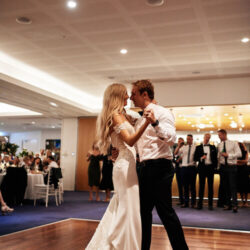
Most couples want the same thing from their first dance: something that looks good, feels natural, and does not require six months of dance training to pull off.
The good news is that an easy choreography — one built around a small number of well-chosen moves — almost always looks better than an ambitious one executed badly. Simplicity done well beats complexity done nervously every time.
Here is how to build one.
What makes a first dance choreography “easy”
Easy does not mean boring. It means achievable — a routine that two non-dancers can learn in four to six weeks of regular practice and perform confidently in front of a room full of people.
The difference between an easy choreography and a difficult one comes down to three things:
Move count. A first dance typically runs two and a half to three minutes. You do not need thirty different moves to fill that time. Five or six well-practised patterns, rotated and repeated with confidence, will look far better than fifteen moves half-learned in a panic.
Move selection. Some moves look impressive but are genuinely hard to execute well — dips, lifts, and fast spins all require technique that takes time to build. Others look elegant and are much more forgiving: travelling steps, slow turns, simple separations with a clean return. A good easy choreography leans on the second category.
Structure. Knowing what move comes next, without having to think about it, is what makes a couple look natural on the floor. The choreography needs to be memorised well enough that attention is free to go on connection, expression, and actually enjoying the moment.
The building blocks of an easy first dance
These are the moves that work consistently well for beginner couples — they look good, are achievable with regular practice, and form the foundation of most first dance choreographies:
The basic step. The foundation of everything. A simple weight transfer that establishes your rhythm and gives you somewhere to return to between patterns. Not glamorous, but essential — and when done with good posture and connection, it looks far better than people expect.
Travelling. Moving around the floor together rather than staying in one spot. It fills space naturally, keeps the dance dynamic, and is simpler to execute than most couples assume. A few steps forward, a curve, a change of direction — the room reads it as confident and polished.
A simple turn. One underarm turn for the lead partner, done slowly and cleanly, is one of the most effective moves in a first dance. It creates a visual moment, works with almost any song, and takes a few sessions to learn reliably.
A separation and return. A moment where the couple steps apart slightly and comes back together. Used once or twice in a routine it adds variety and looks choreographed without requiring technical skill.
A closing move. How you end the dance matters as much as how you start it. A simple dip — even a shallow one — or a held pose on the final note gives the audience something to respond to. Practise the ending as much as anything else.
How to structure three minutes
A common mistake is to think about moves in isolation rather than as a sequence. Here is a simple framework that works:
Opening (0:00–0:30): Start with your basic step. Establish your connection, settle your nerves, find the rhythm. Do not try to do anything impressive in the first thirty seconds — just move together calmly.
Build (0:30–1:30): Introduce your main patterns one at a time. A travelling section, your first turn, back to basic, a separation and return. Keep it unhurried. Repeat patterns you feel confident in rather than rushing through everything you know.
Middle (1:30–2:00): This is where you can add your most confident move — whatever you have practised the most and enjoy doing. It does not need to be technically difficult. It just needs to land cleanly.
Close (2:00–end): Wind back to something simple and controlled. Save your ending move for the final note. Hold it for a count of two before stepping apart.
The role of your song
An easy choreography still needs to be built around your specific track — the tempo, the phrasing, and the emotional shape of the song all affect how the moves should be timed and sequenced.
This is where most DIY approaches fall short. Generic choreography that does not account for your song will look slightly off — the moves do not land on the right beats, the structure does not match the music’s natural peaks and pauses. It is subtle, but an audience feels it.
The Wedding Dance Tutorial builds your choreography around your actual song from the start. The personalised preview shows you what your specific track looks like with choreography on it — before you commit to learning anything.
How long does an easy choreography take to learn?
For most couples with no prior dance experience, four weeks of consistent practice is enough to feel genuinely confident with an easy choreography. That means two or three sessions per week of around twenty to thirty minutes each.
Six weeks is comfortable. Eight weeks means you will have the routine so well embedded that you can actually enjoy performing it rather than just surviving it.
The most important variable is not talent — it is consistency. Short, regular sessions beat long infrequent ones every time.
Common mistakes that make easy choreography look harder than it is
Rushing. Non-dancers tend to speed up when nervous. Practise at a slightly slower tempo than feels natural — it will land at the right pace on the day when adrenaline kicks in.
Looking at your feet. It feels necessary and it almost never is. Once you know the moves, looking at each other rather than the floor transforms how the dance reads to an audience.
Overcrowding the routine. Adding more moves because you feel the routine looks too simple is the most common mistake couples make in the final week. If it is working, leave it alone.
Neglecting the ending. Couples often practise the opening and middle extensively and run through the ending quickly. The ending is what the room applauds. Give it equal time.
Where to start
The Wedding Dance Tutorial is built specifically for this — an easy, achievable choreography personalised to your song, with step-by-step instruction from foundations through to final polish.
If you want to see what your first dance could look like before you commit, the free preview builds a short video set to your actual track. No card required.
See plans → Try the free preview →Related: The Best Wedding Dance Tutorials Online — What Actually Works for Non-Dancers
Related: Online Wedding Dance Tutorial vs Private Lessons — Which Is Right for You?
Anthony Auffret is the founder of Wedding Dance Tutorial and First Dance Academy. He has been teaching couples to dance for over 20 years.